

Current ethical guidelines prohibit the fund from investing in companies such as Airbus, BAE Systems, Boeing, BWX Technologies, and Lockheed Martin
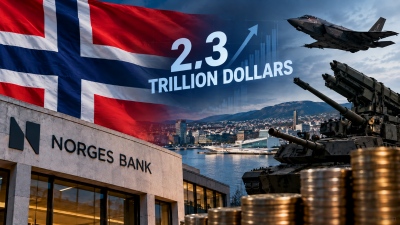
Norway is considering a significant shift in its sovereign wealth fund's investment strategy, paving the way for the re-inclusion of major American and European defense contractors in its portfolio following years of exclusion for much of the sector due to state ethical guidelines. The nation's sovereign wealth fund is currently valued at approximately $2.3 trillion, making it the largest fund of its kind globally. Holding stakes in roughly 1.5% of listed companies worldwide, it stands as one of the largest investors in international equity markets. In November 2025, a mandate was issued to review the ethical guidelines governing Norges Bank's investments following backlash triggered by divestments from certain Israeli and American firms. However, the independent Gjedrem Committee submitted its review findings to the Norwegian Ministry of Finance. Among other points, it proposed a radical shift in the fund's approach toward defense investments, arguing that "Norges Bank must be prepared for situations where conflicts escalate into war."
Companies that could return
Existing ethical guidelines prohibit the fund from investing in companies such as Airbus, BAE Systems, Boeing, BWX Technologies, and Lockheed Martin, as they are involved in the production of nuclear weapons. Nonetheless, the fund maintains holdings in certain defense firms, including a 2.3% stake in Germany's Rheinmetall and 1.5% in Italy's Leonardo. The Gjedrem Committee stated Thursday that while the exclusion criterion regarding nuclear weapons should be maintained, "its scope of application should change." "The fund should not invest in companies that produce nuclear weapons, unless the company is headquartered in a state possessing nuclear weapons under the Non-Proliferation Treaty (NPT) and is an ally of Norway," the report states. "Consequently, several European and American companies manufacturing components for nuclear weapons could be re-integrated into the investment portfolio." The committee added that potential investments should also include firms producing weapons systems required for Norway's own defense. Concurrently, it recommended eliminating the requirement to evaluate arms manufacturers on whether their products are used by states in accordance with international humanitarian law.
Geopolitical instability
The committee noted that amid rising geopolitical instability, wars in the Middle East and Ukraine, as well as energy security concerns, the fund's scale and influence render a "review of the ethical framework timely." "The size and reach of the fund offer better access to corporate managements and boards of directors compared to 2003," the report notes. "In a period when the external political environment grows more demanding, this creates opportunities that management should leverage." "The liberal rules-based international order is in decline," the committee adds. "Economic policies are increasingly deployed as foreign policy tools. In recent years, interstate cooperation has become more transactional and negotiation-oriented." The committee warned that in this environment, other governments might more easily perceive company exclusions on ethical grounds as political decisions by the Norwegian government.
Background
Norway's oil fund was established in the 1990s to invest state revenues generated by the petroleum sector. Although Norway's Ministry of Finance and central bank participate in fund governance, investment decisions are made by Norges Bank Investment Management (NBIM). Previously, recommendations for company exclusions were submitted by the independent Council on Ethics. "There have been reactions and threats of countermeasures," the Gjedrem Committee stated in its report Thursday. "Retaliatory actions could harm the fund and other Norwegian interests."
US reactions
In September of last year, the US Department of State told CNBC it was "very concerned" by NBIM's decision to divest from American machinery manufacturer Caterpillar and five Israeli banks, accusing the fund of relying on "unsubstantiated claims." NBIM had cited an "unacceptable risk" that these specific companies contributed to rights violations in Palestinian territories to justify the divestment. Norway's Minister of Finance, Jens Stoltenberg, former NATO Secretary General, stated at the time that it was "a non-political decision." On Thursday, the Gjedrem Committee pointed out that the risk of fresh reactions against NBIM's investment choices is growing as public finances in many countries face mounting pressures. "High public debt can jeopardize countries' economic stability, but it can also create incentives to seek state revenue in investment interests and dividend income from foreign investors," it warned. Committee members concluded that while the rules governing the fund's ethical framework continue to enjoy broad support, they have come under strain due to the political environment. "Conditions for exercising shareholder rights have become more restrictive, including in the US," they noted.
Changes in the role of the Council on Ethics
The Gjedrem Committee recommended continuing the operation of the Council on Ethics, but with an altered role. Specifically, the Council will no longer advise NBIM on taking action over ethical matters. Instead, it will be limited to conducting analyses on company violations of ethical rules. No new company will be immediately added to or excluded from the fund's investment portfolio as a direct result of the report's recommendations. However, the proposals clear the path for investments in certain American and European defense contractors currently excluded under ethical rules. Norway will now conduct a public consultation on the report's proposals, with the central bank expected to submit its response in January. The Ministry of Finance will present a new ethical framework in a special government report in the spring, while the Norwegian parliament is expected to vote on the changes in mid-2027. Until then, current ethical rules and the fund's corporate exclusion framework remain unchanged. "The Council on Ethics has just received the Gjedrem Committee report," Svein Richard Brandtzæg, chairman of the fund's Council on Ethics, said in a written statement Thursday morning. "We will study the report carefully. Subsequently, we will hold thorough internal discussions within the Council and submit our response as part of the upcoming public consultation."
Until November 2025, Norges Bank's Executive Board decided whether companies would be excluded from the fund's investment portfolio or placed on a observation list. Those decisions were based on recommendations from the Council on Ethics, an independent body appointed by Norway's Ministry of Finance. However, pending the completion of the review by the Gjedrem Committee, temporary rules were put in place under which Norges Bank could no longer make such decisions. The temporary rules stipulated that the executive board could only revoke previous decisions to exclude a company or place it on an observation list. Concurrently, the Council on Ethics was stripped of the ability to recommend observing or excluding companies, at least until the review of the ethical framework is finalized. The temporary rules will remain in effect until the 2027 parliamentary vote on the revision recommended by the Gjedrem Committee.
www.bankingnews.gr






Σχόλια αναγνωστών